9/11 Mohawk Eagle Dance Memoir

Jerry “Thundercloud” McDonald and Tonya Frichner

9/11 MOHAWK EAGLE DANCE MEMOIR

I was on the freeway to Atlantic City on September 11, 2001, when someone phoned my friend who was driving to tell of the catastrophe. As far as I know I didn’t lose anyone I was acquainted with nor related to. But I was involved in a particularly poignant way with the Mohawk High Steel Workers who both helped build the Trade Center Towers and were now called upon to unravel the metal labyrinths the tragedy left behind.

I was friends with Kamala Cesar who was a member of my Floating Lotus Magic Opera Company in the late 60s in Berkeley, California. She had gone on to a career of traditional study from South Indian Dance Master Balasaraswati, performing and then teaching it, and establishing the studios of Lotus Music & Dance in New York over the forty years since the disbanding of the theater company. One of the teacher-performers at her studio, Jerry “Thundercloud” McDonald, a blood member of the Mohawk Nation (as is Kamala) was deeply impressed by a performance of The Dance Theater of Harlem he had seen, and got the idea to do a similar presentation of an adapted Mohawk Eagle Dance within a modern dance context. Now he needed an overall vision as well as scenario and director of all but the actual dances, so Kamala asked me to come up from Philadelphia to New York to meet him and his wife Tonya Frichner, and see how I might be inspired to get involved.

I arrived at the appointed restaurant, and during lunch learned that Mohawk Indian Jerry was also a High Steel Worker, one of those tiny ant-men walking in the sky along girders on skyscraper construction sites with death-defying grace. He described in detail truly harrowing experiences he and other High Steel workers had had on very narrow steel beams often forty or more stories high, since it was discovered by construction engineers that Mohawk Indians would go where other workers wouldn’t dare. They were able to glide like tightrope walkers on four-inch wide girders, riveting giant steel beams in place by hand-guiding them to their perpendicular frames, often without more than flimsy safety belts, or out in space with nothing at all below them. I could feel the hair standing up on the back of my neck as he described all this. But here was a perfect dance piece: the presentation of a traditional Mohawk Eagle Dance within a scenario of modern dancers interpreting movements of the workers, even using the actual language of gestures with which they communicate instructions from ground to sky, guiding and helping, as well as imitating the teetering balancing and sliding along movements of these brave native athletes.

We interviewed and taped some of the Mohawk workers and more importantly their long-suffering wives and relatives, who openly expressed their often fearful anguish for their men going off to work, constantly praying for their safety. This was now an established family tradition among many Mohawks (as well as others), often comprising all the men in a family, they having found a money-making niche with little competition. (An interesting detail: families with more than one High Steel Worker would not allow them all to go to work at the same time, in case one died, as happened famously at an extension bridge site in Canada early in the century, where all the men of families that had gone to work were wiped out by a single accident.) The resulting tapes were then edited, with repeats of key words and phrases in rhythmic (Steve Reich-like) segments, to make up part of the musical component the modern dancers in overalls and hardhats would dance to. Mohawk Elder Tom Porter would give an opening invocation. The Eagle Dance would be danced by Jerry and his wife Jeannie, in gorgeously white-feathered array, and actual Steel-Workers who were also traditional drummers and singers would accompany them with drumming and singing in the Mohawk language. The modern dancers led by Jaan Freeman were New York’s extraordinarily inventive dancer-choreographers, including one lithe soloist who flew and then caught a huge Malaysian eagle kite I found in a Philadelphia import store and suggested he try incorporating into a dance.

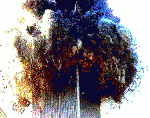
We were meant to premiere the piece on September 22, 2001. It was all arranged, and we were ready. Then came September 11th. The premiere had to be canceled until a later time. I traveled by train up to New York to a meeting on the 15th to decide what to do, and walked the long, shocked street from Penn Station at 8th Avenue to a little studio on 58th Avenue to meet with the cast. The Mohawk steel-workers were at Ground Zero. It turns out that a number of the older workers had helped construct the Twin Towers in the first place, and they were now being called upon to help untangle the wreckage they knew so well, girder by girder, these eagles, these high steel acrobats of courage and daring, our own ravaged indigenous natives building and unbuilding our modern skyscrapers, now in toxic birds’ nests of twisted metal and human carnage, at the hell-center of a tragedy brought about by fanatical hatred fueled by America’s financial and deeply biased and implicated Empire.

Eagle Spirit: A Tribute to Native High Steel Workers was finally presented in New York many months later. Many of the native dancers and singers who performed in the evening, in a darkened theater, with their drums and feathers, had spent their day working in the toxic dust and wreckage at Ground Zero.
___________________________________________________
(original notice)

Eagle Spirit: A Tribute to Native High Steel Workers

This collaboration between Mohawk dancer/ironworker Jerry McDonald, African-American modern dancer Jaan R. Freeman, and the poet Daniel Moore honors the Mohawk high steel workers who have built much of the New York skyline. This work combines Mohawk traditions with contemporary music and dance, bringing together the nimble steps required to walk on swaying beams 500 feet above the pavement with dance that is 1,000 years old. Guest artists include the Mohawk Singers, the Thunderbird Dancers, the Onondaga Nation Smoke Dancers, and the Akwesasne Women Singers. Mohawk Elder Tom Porter will open the program with ironworker stories and traditional teachings of the Longhouse.

9/11 Poem: Ramshackle Shack Parts 1-4


A LITTLE RAMSHACKLE SHACK

PART 1

A little ramshackle shack on a hill
blown apart by the wind
door roof and walls lofted aloft and sent flying
no weightier than paper upon which is casually written
a name
twists in the air almost signals goodbye then
suddenly is gone only
bare hillside left behind
a goat now stands upon
two goats a small herd after the wind’s died down
straggle along distractedly
chewing

Madame X is led out to the guillotine where a
head once encircled by ermine on a tall neck once
encircled by strings of pearls and glittering diamonds
rolls like a dark pearl into a basket its
eyes rolled heavenward its body relaxed
backward like a flung necklace onto a
marble tabletop in an
empty room after the
ball is over
_____________________________________________________________

(NOTE: At first I had no intention of writing a poem about the event, and was bereft of thoughts
toward any poem, stunned as everyone, with convulsions of feelings. The first part above came as
metaphoric, irrational, that I now see in aspects of our essential transience, ourselves and our
buildings, gone in a flash… the first shock I think we all felt in some way. The great New York
fortress of permanence and wealth, now vanished. Then Madame X, like the nobility of the French
Revolution, summarily executed, justice waived, a sudden blow to the grand ball of American might,
now irrevocably vulnerable. But these hard and emblematic images are not the human story of actual
deaths that day, taken up in Part 2.)
___________________________________________________________________

PART 2


Imagine the precise and daunting gears and
levers of the decree that led to all those innocent
people meeting death at the World Trade Center in
New York September 11, 2001
all the little accumulating gestures and maneuvers that
put them at their desks on schedule in time to die
the horrific fireball of the angel of death who may have
appeared to them all at the last as
cool refreshing waterfalls of light or open
delightful corridors leading to emerald green
gardens so bright with joy they forgot completely
how they got there

We all wonder how we’ll die
hoping for a soft bed in a warmly lit room surrounded by
loved ones after a short and not too uncomfortable
illness a kind of light cough or a
stitch in the side and that’s all
never imagining falling to the ground from 110 stories in the air
or twisted in molten steel like a tyrant’s cage
in suffocating smoke

Unthinkable

The high school diplomas the happy
vacation moments in Cancun across a turquoise pool
the epiphanies while reading Moby Dick
the birthday banquets with long-lost relatives
the recent wedding or long-awaited love letter received

It’s a lone figure in a woolen hat on a sheer white hillside
whose coat trails the ground and whose
footprints evaporate once the meeting’s taken place

It’s unfathomable and beyond any human
words devised to describe it
and for all those souls lost in the New York disaster
whose accidental but destined martyrdom is absolutely assured
(except ironically to the fanatically deluded
hell-bound perpetrators of the unthinkable
disaster itself)

there are coats of eiderdown so soft and pearls so ethereally gorgeous
so filled with subatomic music that pours out of
every gap in their weave to envelop the air in
ecstatic choir

And the divine shadow of Truth moves aside to let pour
a radiance so pure every moment set in motion in time
one step after another year after year that led to their
being there in the right place at the
supreme right time
suddenly becomes a series of perfect stepping stones like floating
lily pads over deep black water to a Paradise even our
most ornate imaginations cannot adequately imagine
___________________________________________________________________

(NOTE: This section is thinking the unthinkable, that those who died that day
were us, in so many ways, but in deeply personal detailed ways, which made it
all the more raw and poignant. This was our American Tragedy, inflicted by a
concatenation of rationales, but suffered wholesale by innocents. But by our
beloved Prophet’s statements, peace of Allah be upon him, such deaths warranting
Paradise, while “ironically” the opposite for such idealogue perpetrators, deluded
that such a Paradise is for them. But Allah knows best.

This morning musing on the enigmatic first part of this poem, I thought about
the goats left in the buildings’ void, and recalled, for the first time all
these years later, the words of the Hadith regarding Signs of the End of Time
that one is “ragged herders of goats vying with each other in building tall
buildings…” or words to that effect.
_____________________________________________________________________________


PART 3

People are very involved with having
faces and eyes and thoughts of their own and
smells in the odorous parts of their
bodies where the human anatomy dictates

They move with a certain self-consciousness which is sometimes
nonchalant and at other times unnatural
they can feel their spines hunched or vertically straight
and how their rib-cages make room for their
breathing

People are curious capsules of atmospheres and internal weathers
and at complete ease are either blessed with expansive
horizons or cursed with tics and foibles that
intensely constrain them
a consciousness that may include the Serengeti for example with
all its wild flora and fauna or the
bleached out and tattered prospect of simply
four walls a ceiling and a floor

Young ones often betray a jumpy and eager quality
old ones a sleepy and generally exhausted quality though they
may achieve beneficence from time to time as their
bones creak and their nerves ache

But each one is categorically a cosmos and has vivid
cosmological thinking and a deep appreciation of its consequences
and each one experiences the end of the
world when death appears like a
yawning sea to drown them in its
perpetuity

drawing back within it the
essence of their beauty
______________________________________________________________________

(NOTE: This third part may seem redundant of the second part, but in retrospect it seems
I may not have felt I’d quite thrown myself inside the people lost with enough empathy,
and have now doubled down, as it were, on our essential humanness, the spirit of humanness.
As Whitman said, “I am a cosmos,” and as Allah in the Qur’an has stated,
“if someone kills another person — unless it is in retaliation for someone else or
for causing corruption in the earth — it is as if he had murdered all mankind [5:32],”

and the Sufis say, “Man is a little cosmos, and the cosmos is a big man.”

So this section of the poem is a rhapsody of the innermost reality of each person born,
which we all instinctively know in our own humanity, and can clearly see and know directly
through the vision of our hearts.)
___________________________________________________________________________


PART 4

This is the music space
where music is most difficult
this place of joy and horror
sound of fuselage entering steel as if
slicing through butter

This is the silence out of which
all the thrilling chords emerge

This is the space of the silence of souls
at their moment of release

This is the air over a dewy wheat field
crackling like cellophane in the morning light

This is the music space
voices in a room of those
visible and those who are invisible

I think the music of the spheres
can be heard in this space

It’s the sound of life
which takes place without echo
or is nothing but echo

And the original sound is the
sound of God alone audible to Himself
and we are the humming elements of that sound

This is the music space
we hear it this very moment

It’s the sound of hooves
and nothing at all like the sound of hooves

It’s the endlessly heaving ocean-sound
which turns out to be our blood beating
and the deep tidal push of our own heartbeats

Each whisper of love and fear and grief
rises in this music space

And one single note is enough to fill it

And silence itself is part of it

And the silence or the sound that follows it
is also part of it
_______________________________________________________
9/15-16 (from The Music Space, Ecstatic Exchange, 2007)

(NOTE: I first read this poem in its entirety in public at an event produced by the New York ASMA Society
in Grace Cathedral, January 19, 2002, Reflections at a Time of Transformation.
Faced with the unspeakable, with some people shocked out of their beliefs and others
suddenly unjustly held responsible for having beliefs (and I don’t mean the fanatic ones),
this final part lifts into another realm, a music space, with the first three parts providing
its human foundation, with God willing a sense of His overarching Majesty and Beauty over all.)